
Brierly
from download to your own forecasting trainer.
Brierly is an Android and iOS app that trains forecasting skill. For each public question the user commits their own probability before seeing the crowd, then gets a Brier score and a calibration curve. This guide takes you from the download to a branded build in the stores, step by step. Read it top to bottom the first time; after that, press / and search.
01What you bought
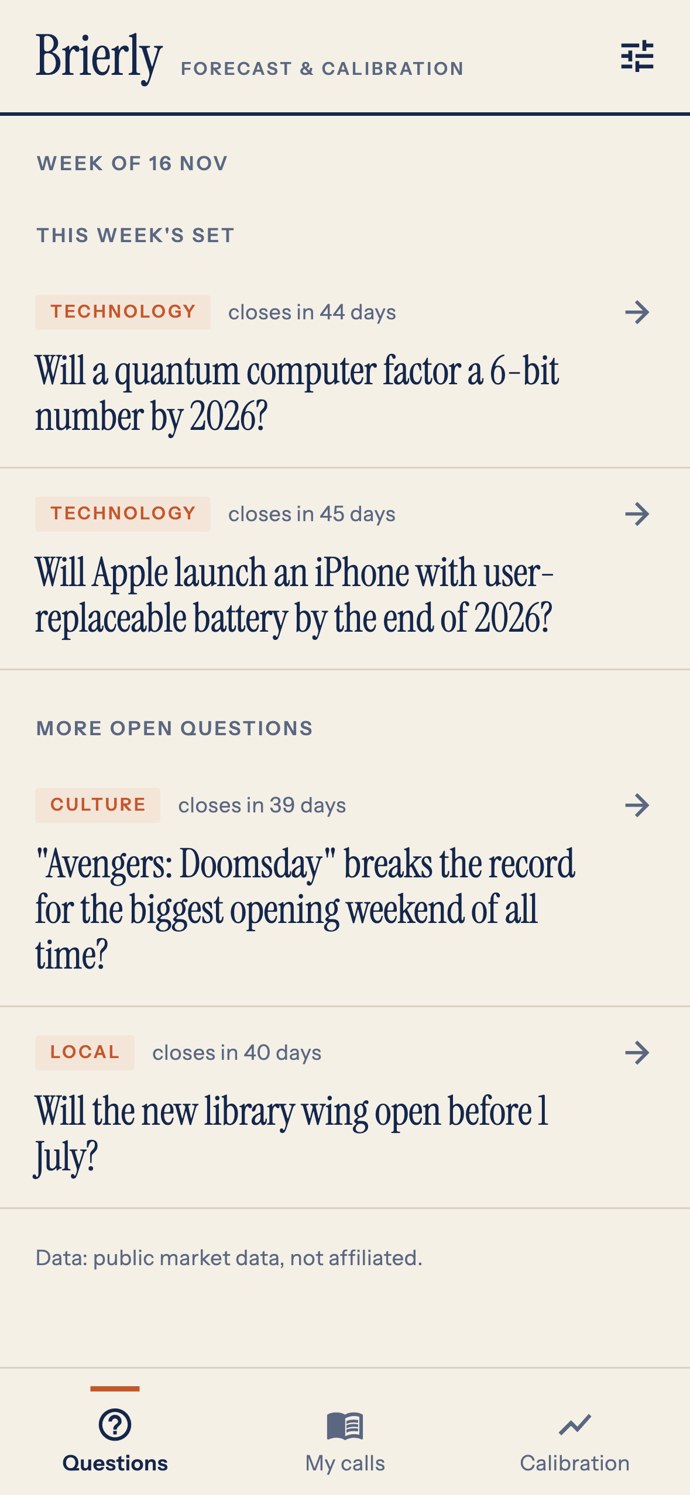
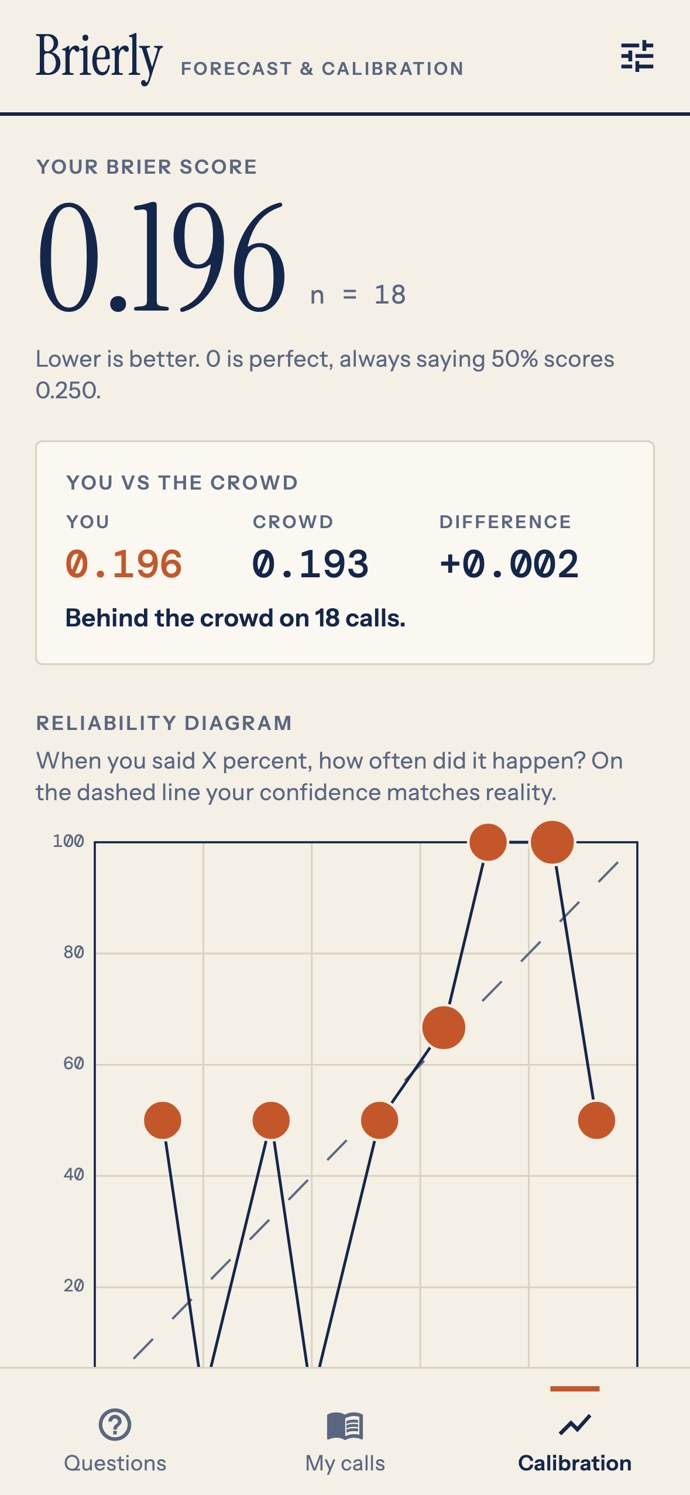
Brierly is complete, white-label mobile app source code plus a small server with an operator console. The user opens a public question, drags a slider to set their own probability of Yes (1 to 99 percent) with the crowd's odds hidden, and seals the call. Only after that does the app show what the crowd thought. When the question is decided, the app computes the user's Brier score, draws a calibration curve (reliability diagram) and compares the user with the crowd on the same questions. A Pro tier, sold through in-app purchases, lifts the weekly call limit and the history limit. All forecasts and scores stay on the phone.
Brierly is a forecasting-skill trainer for learning to estimate, nothing more. It has no wallet, no order buttons, no advice and no link to any market's own page. Please describe your app the same way in your store listing.
| Part | Folder | What it is |
|---|---|---|
| Mobile app | app/ | Flutter project for Android and iOS. Without a server it runs on its own: no questions arrive (an honest empty state is shown) but history and scores still work. |
| Server | server/ | Node.js backend that serves the questions, with an operator console: choose the question source, hide or feature questions, add your own, resolve them, change the paywall, features, announcement and force update without a new build, and optionally confirm purchases with the stores. |
| Contract | contract/CONTRACT.md | The calls between app and server, with example JSON. |
02Folder map
| Path | What is inside |
|---|---|
app/lib/brand.dart | App name, tagline, accent colour, fonts, default attribution line, support/privacy/terms links, default store product ids, server address. The one file for rebranding. |
app/lib/src/ | Dart code: core/ (models, scoring, config), data/ (SQLite store of calls), services/ (controller, purchases, question API, config client, ping, settings), ui/screens/ (Home, Question, Calls, Calibration, Settings, Paywall, Onboarding, Update). |
app/android/ | Android project (MainActivity.kt is the standard activity). |
app/ios/ | iOS project, PrivacyInfo.xcprivacy and the Swift app and scene delegates. |
app/assets/fonts/ | Instrument Serif, Instrument Sans and DM Mono fonts with their licence texts. |
app/tool/make_icon.py | Script that draws the app icon. |
app/test/ | Automated tests (scoring, blind call, config, paywall, screens). |
server/src/ | TypeScript server: app.ts (routes), market.ts (question sources), questions.ts (storage), purchases/ (App Store and Google Play checks), admin/manifest.ts (what the console shows). |
server/packages/admin-kit/ | The operator console (MIKODES Admin Kit), licensed with this item. |
server/.env.example | Every server setting, with comments. |
server/Dockerfile | Container build for the server. |
03How it fits together
The app keeps every forecast on the phone. The server serves the questions and settings. The phone never calls the question source itself: your server does, keeps its own cache, and hands out the crowd's odds only at the moment a call is sealed. Arrows point from the part that calls to the part that answers.
04Quick start (about 20 minutes)
Flutter runs natively on Windows: use PowerShell for the flutter commands and Android builds (iOS builds need a Mac). For the server, either install Node.js 22.12+ for Windows and use PowerShell (replace cp .env.example .env with Copy-Item .env.example .env; there is no openssl by default, so use WSL or any random 64-character hex string), or run the commands in WSL 2 (Ubuntu) or Docker. macOS and Linux users can ignore this note.
- Install Flutter 3.41 or newer (see Requirements) and run
flutter doctoruntil it shows no red items for the platform you want. - Start the server (it provides the questions).
Opencd server cp .env.example .env openssl rand -hex 32 # paste the result after ADMIN_SECRET_KEY= in .env npm ci npm run build npm starthttp://localhost:8787/adminand follow First sign-in. Check that questions arrive:curl http://localhost:8787/v1/questions. - Run the app against it.
Connect an Android phone with USB debugging on, or start an iOS simulator. The address must be https: the project sets no plain-http exception, so acd app flutter pub get flutter test flutter run --dart-define=API_BASE_URL=https://your-server.example.comhttp://localhostaddress is refused by current Android and iOS (see Installation). WithoutAPI_BASE_URLthe app still runs, with an empty question list. - Rebrand. Follow Rename and rebrand: name, package id, bundle id, icon, colours.
- Choose your question source and read its terms: Market data source.
- Create the store products and put their ids in the app or the console: Store products.
- Build and publish: Release builds and signing.
A read-only demo of the operator console is at https://brierly-demo.mikodes.com/admin. Email: demo@brierly.demo · Password: brierly-demo-2026 (read-only demo account).
05AI tools
AI tools were used to assist with parts of the code, documentation and graphics of this item. The author reviewed and tested the result. The product itself contains no AI features.